World War II
1944
World War I
German Tiger II
The Tiger II, commonly known as the "King Tiger" by Allied forces, was Germany's ultimate production heavy tank. Combining the thick sloped armor pioneered by the Panther with the formidable 8.8 cm KwK 43 L/71 gun, it possessed unmatched defensive protection and long-range firepower. Introduced in 1944, the Tiger II was capable of destroying any Allied tank at distances beyond the effective range of most opposing weapons, although its immense weight reduced strategic mobility and placed considerable strain on its mechanical components.

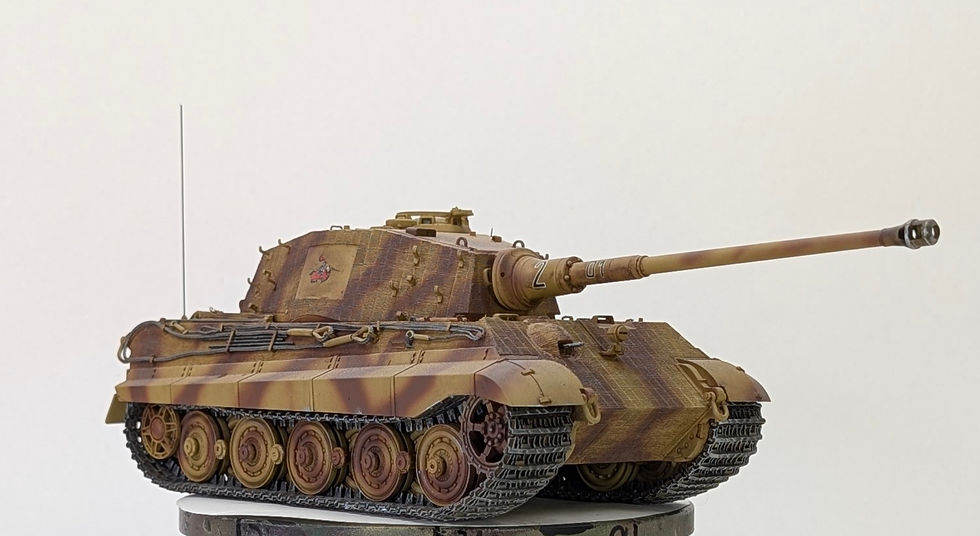

The Tiger II was designed as the successor to the Tiger I, incorporating lessons learned from combat against increasingly capable Allied tanks. Engineers adopted heavily sloped armor while retaining the powerful long-barreled 88 mm gun, creating one of the most formidable armored vehicles of the war. Although the design excelled in firepower and protection, production was expensive and technically demanding. Mechanical reliability, fuel shortages, and Germany's deteriorating industrial situation prevented the Tiger II from being produced in sufficient numbers to significantly alter the course of the conflict.


German Marder I 39(H)
The Marder I auf 39(H) was a German self-propelled tank destroyer created by converting captured French Hotchkiss H39 light tanks into mobile anti-tank vehicles. Armed with the effective 7.5 cm PaK 40 gun, it provided German forces with valuable mobile firepower while making efficient use of captured equipment. The vehicle served primarily in France, where it strengthened coastal defenses and later opposed Allied forces following the Normandy landings.


After the 1940 campaign in France, Germany captured hundreds of Hotchkiss H39 tanks that were no longer suitable for frontline armored service. Engineers removed the turret and installed an open-topped armored fighting compartment mounting the powerful PaK 40 anti-tank gun. Although lightly protected, the conversion was inexpensive and relatively quick to produce. The Marder I auf 39(H) extended the operational life of captured French vehicles while providing an effective interim solution until purpose-built German tank destroyers became available.


German Jagdpanther
The Jagdpanther was one of the most effective tank destroyers fielded during the Second World War. Built on the chassis of the Panther medium tank and armed with the powerful 8.8 cm PaK 43 L/71 gun, it combined outstanding firepower, heavy sloped armor, and excellent mobility. Capable of destroying virtually every Allied tank at long range, the Jagdpanther served with distinction on both the Eastern and Western Fronts from 1944 until the end of the war.


The Jagdpanther was developed to combine the proven Panther chassis with Germany's most powerful anti-tank gun in a low-profile casemate. Engineers emphasized sloped armor and mechanical reliability while maintaining the Panther's superior mobility. The resulting vehicle achieved an exceptional balance of protection, firepower, and maneuverability, making it one of the finest tank destroyers of the war. However, Allied bombing campaigns and shortages of raw materials limited production to fewer than 400 vehicles.


German Jagdtiger
The Jagdtiger was the heaviest operational armored fighting vehicle of the Second World War. Built on the Tiger II chassis and armed with the formidable 12.8 cm PaK 44 L/55 gun, it possessed unparalleled firepower and exceptionally thick armor, allowing it to destroy Allied tanks at extreme ranges while remaining virtually immune to frontal attack. Entering service in 1944, the Jagdtiger served primarily on the Western and Eastern Fronts, where its immense combat capability was often offset by mechanical unreliability and limited mobility.


The Jagdtiger was developed to provide Germany with a heavily armored tank destroyer capable of defeating any Allied armored vehicle. Engineers mounted the massive 128 mm anti-tank gun within a heavily armored casemate on the proven Tiger II chassis, creating a vehicle with unmatched long-range firepower. However, its enormous weight placed considerable strain on the suspension, transmission, and engine, leading to frequent mechanical failures. Combined with fuel shortages and limited production, these factors restricted the Jagdtiger's overall impact despite its formidable battlefield performance.


German Hetzer
The Jagdpanzer 38(t), commonly known as the "Hetzer," was a compact German tank destroyer built on the reliable Czech Panzer 38(t) chassis. Armed with the effective 7.5 cm PaK 39 L/48 gun and protected by sharply sloped armor, it offered an excellent balance of firepower, protection, and mobility in a relatively inexpensive package. Entering service in 1944, the Hetzer proved highly effective in defensive operations and remained in frontline service until the end of the war.


The Hetzer was developed to replace earlier open-topped tank destroyers with a fully enclosed, low-profile vehicle that was easier to produce and better protected. Engineers extensively redesigned the Panzer 38(t) chassis to incorporate sloped armor and a compact fighting compartment while retaining the proven suspension and drivetrain. Although the cramped interior limited crew comfort, the design's simplicity, reliability, and effective armament made it one of Germany's most successful late-war armored vehicles.


British A27M Cromwell Mk. VIII
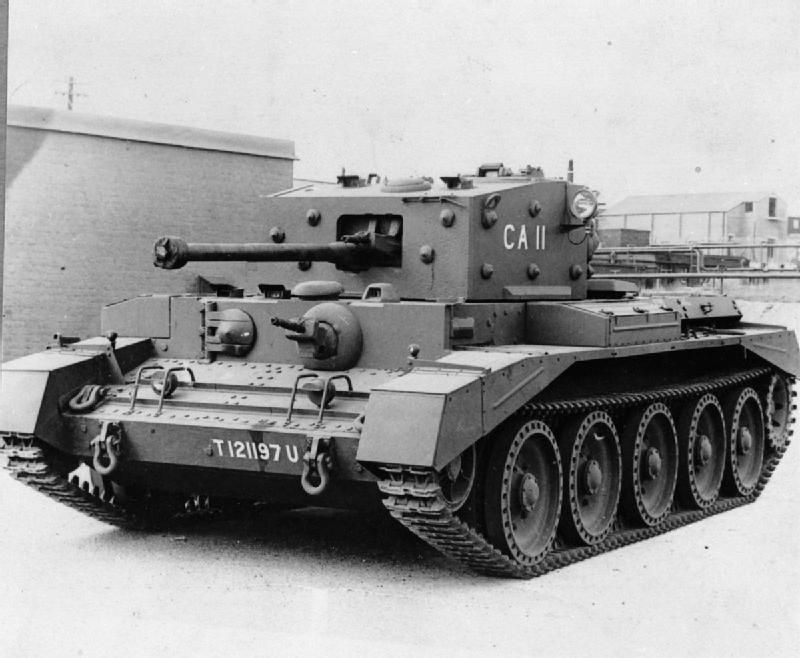
The A27M Cromwell Mk. VIII was a close-support variant of Britain's highly successful Cromwell cruiser tank. Replacing the standard high-velocity 75 mm gun with a 95 mm howitzer, it was designed to provide direct fire support against infantry, bunkers, and fortified positions while accompanying standard Cromwell units. Its combination of high speed, reliability, and powerful high-explosive fire made it a valuable support vehicle during the campaigns in Northwest Europe.


The Cromwell was developed to provide the British Army with a fast, reliable cruiser tank powered by the Rolls-Royce Meteor engine. The Mk. VIII adapted the basic design to the close-support role by installing a 95 mm howitzer capable of firing high-explosive and smoke ammunition. This specialization allowed Cromwell formations to maintain mobile fire support without relying solely on towed artillery. The close-support concept complemented standard gun tanks and reflected British doctrine emphasizing combined-arms operations within armored formations.


British A34 Comet
The A34 Comet was Britain's final cruiser tank of the Second World War and one of the most capable Allied tanks to see combat. Combining excellent mobility with the powerful 77 mm High Velocity gun, it provided British armored units with a vehicle capable of engaging German Panthers and Tigers while retaining the speed expected of a cruiser tank. Entering service in late 1944, the Comet played an important role during the final campaigns in Northwest Europe.


The Comet was developed as an improved version of the Cromwell in response to the need for greater firepower against advanced German armor. Engineers retained the reliable Cromwell chassis while incorporating a redesigned turret mounting the new 77 mm HV gun, a compact weapon derived from the famous 17-pounder. Improvements to armor protection, suspension, and crew ergonomics further enhanced battlefield performance. The Comet's successful design directly influenced the development of Britain's postwar Centurion main battle tank.


German Maus
The Maus was the heaviest tank ever constructed, representing the extreme end of armored vehicle design during World War II. Designed by Germany under the direction of Ferdinand Porsche, the massive vehicle weighed approximately 188 tons and carried a powerful 128 mm main gun paired with a 75 mm secondary cannon. Its exceptionally thick armor made it virtually immune to most contemporary anti-tank weapons.
Despite its impressive specifications, the Maus never entered operational service. Only two prototypes were completed before the end of the war, and the project demonstrated that excessive size and weight created logistical and mechanical problems that outweighed any tactical advantages.


Development of the Maus began in 1942 when Adolf Hitler expressed interest in an ultra-heavy breakthrough tank capable of surviving any battlefield threat. Porsche and other German engineers designed a vehicle with unprecedented armor protection and firepower, intending it to dominate enemy defenses.
The enormous weight of the tank created numerous engineering challenges. Conventional bridges could not support it, transportation was extremely difficult, and mechanical reliability suffered under the strain of moving such a massive vehicle. Designers even considered underwater river crossings using snorkel equipment because bridges were often unsuitable.
Testing of the prototypes confirmed that the Maus possessed extraordinary protection and firepower but lacked the mobility necessary for practical battlefield operations. Changing wartime conditions and Germany's deteriorating industrial situation led to the cancellation of the project. Today, the surviving prototype stands as a remarkable example of both engineering ambition and the limitations of super-heavy tank design.


